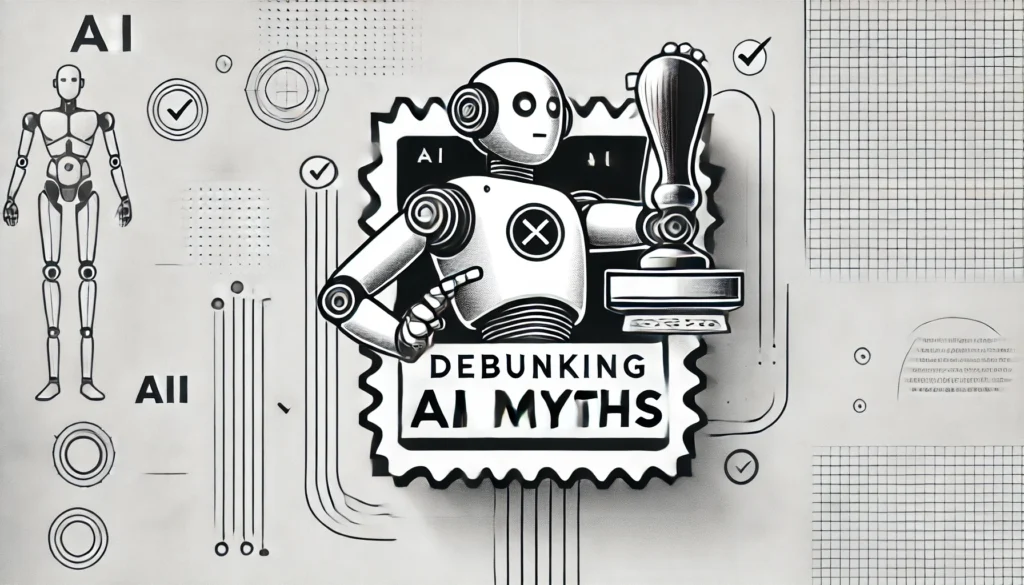
Artificial Intelligence (AI) is one of the most transformative technologies of our time, yet it’s surrounded by myths and misconceptions. From fears of robot overlords to the belief that AI will replace all jobs, these misconceptions often cloud our understanding of AI’s true potential. Let’s set the record straight by debunking five of the most common myths about AI.
Myth 1: AI Will Take Over the World
Debunked: AI is not self-aware, nor is it on the verge of taking control.
Popular culture often portrays AI as an all-powerful entity that could one day dominate humanity. In reality, AI systems are highly specialized tools programmed to perform specific tasks, such as image recognition or natural language processing. They lack general intelligence, self-awareness, and independent decision-making abilities.
Even advanced AI systems like GPT models or autonomous vehicles operate within predefined boundaries. AI development is closely monitored by researchers and governed by ethical frameworks to ensure safety and control.
Myth 2: AI Will Replace All Human Jobs
Debunked: AI will transform jobs, but it won’t eliminate them entirely.
While AI does automate repetitive tasks, it also creates new opportunities. For instance:
- Chatbots handle basic customer service inquiries, allowing human agents to focus on complex issues.
- AI in healthcare assists doctors by analyzing medical images, improving diagnostic accuracy while relying on human expertise.
The key is adaptation. Many jobs will evolve, requiring workers to develop new skills that complement AI technologies, fostering a collaborative human-AI relationship.
Myth 3: AI Is Only for Tech Experts
Debunked: AI tools are increasingly accessible to everyone.
You don’t need to be a programmer or data scientist to leverage AI. Many AI-powered tools, like Canva’s design features, Grammarly’s writing assistant, or voice assistants like Alexa, are user-friendly and designed for non-experts.
Additionally, platforms like no-code AI builders allow individuals and small businesses to create AI solutions without deep technical knowledge. AI is democratizing technology, making it accessible to a broader audience.
Myth 4: AI Is Always Objective and Unbiased
Debunked: AI can reflect the biases of its training data.
AI systems learn from data, and if that data contains biases, the AI will replicate and amplify them. For example:
- Facial recognition systems have been shown to have higher error rates for certain demographic groups due to biased training datasets.
- Language models might unintentionally generate outputs influenced by stereotypes present in the data.
Developers are actively working to mitigate these biases by improving datasets and incorporating fairness measures. However, it’s crucial to approach AI with an understanding of its limitations and imperfections.
Myth 5: AI Can Do Everything a Human Can
Debunked: AI excels in narrow tasks but lacks human versatility.
AI is highly effective in specific domains, such as analyzing large datasets, recognizing patterns, or automating processes. However, it cannot replicate human creativity, empathy, or complex decision-making that requires a deep understanding of context.
For instance:
- AI can compose music, but it lacks the emotional depth of human-created melodies.
- It can assist in diagnosing diseases but cannot replace the nuanced care provided by a human doctor.
AI complements human abilities but doesn’t replace them, making humans an indispensable part of the equation.
Conclusion: Understanding AI’s True Potential
Dispelling these myths helps us embrace AI for what it truly is—a powerful tool designed to enhance, not replace, human capabilities. By understanding AI’s strengths and limitations, we can use it responsibly and effectively to solve real-world problems, improve productivity, and unlock new opportunities.
The future of AI isn’t about machines versus humans—it’s about collaboration. Let’s move past the myths and focus on the incredible possibilities AI brings to our world.